
Asthmatics with more Zinc breath better
Zinc and vitamin C deficiencies associate with poor pulmonary function in children with persistent asthma
Asian Pac J Allergy Immunol. 2020 Dec 2. doi: 10.12932/AP-100620-0878
Siriporn Siripornpanich 1, Nalinee Chongviriyaphan 2, Wiparat Manuyakorn 3, Ponpan Matangkasombut 4 5
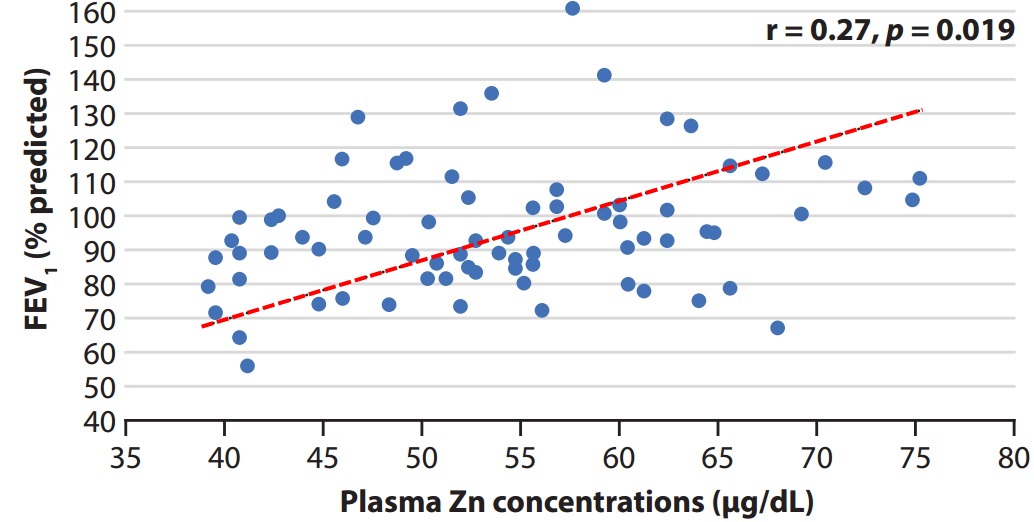
The association between plasma zinc concentrations and forced expiratory volume in the first second (FEV1)
📄 Download the PDF from Vitamin D Life
Background: One of the pathophysiologic mechanisms involved in asthma is the increase in oxidative stress. Zinc (Zn), vitamin C (VC), and vitamin E (VE) have antioxidant functions. However, the status of oxidative stress, Zn, VC, and VE in Thai asthmatic children have not been reported.
Objective: We aimed to evaluate the status of oxidative stress, Zn, VC, VE, pulmonary function tests, and airway inflammation in Thai asthmatic children with persistent asthma.
Methods: In this cross-sectional study, the data was collected from asthmatic children aged 7-17 years. The plasma PGF2α concentration as a marker of oxidative stress was measured using an ELISA kit. Plasma Zn concentration was measured through atomic absorption spectrophotometry. Plasma VC and VE concentrations were determined using HPLC. Pulmonary function tests were evaluated as forced expiratory volume in first second (FEV₁) and forced vital capacity (FVC), using a spirometer. The status of airway inflammation was determined by measuring fractional exhaled nitric oxide.
Results: There were 76 asthmatic children in this study. Seventy-two participants had high oxidative stress. All participants had Zn deficiency. Nearly 40% of participants had VC deficiency. VC deficiency was associated with severe asthma and airway obstruction. Plasma Zn concentrations were positively correlated with FEV₁ (r = 0.27) and FEV₁/FVC ratio (r = 0.65).
Conclusions: Deficiency of Zn and/or VC was related to severe asthma and decreased pulmonary function. Nutrition assessment and management should be considered to alleviate asthma burden.