
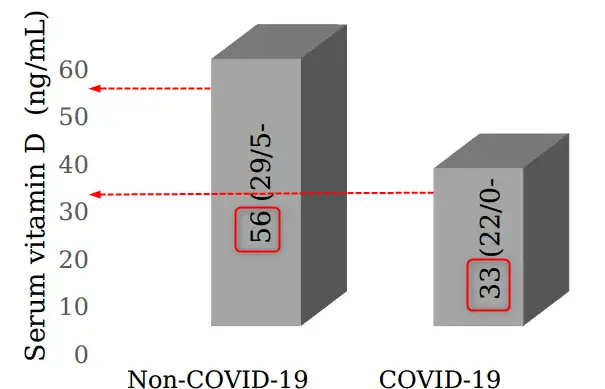
COVID-19 and Vitamin D; non-infection 56 ng, infection 33 ng (Iran)
Nutritional and inflammatory biomarkers for COVID-19 susceptibility: a focus on vitamin D, potassium, and hematological indices
BMC Infectious Diseases 23 Dec (2025)
IntroductionSince its emergence, COVID-19 has caused a global health crisis with multi-systemic complications, particularly affecting the respiratory and cardiovascular systems. Identifying potential risk factors is important for early detection of disease and may improve patients survival. This study was carried out to evaluate inflammatory, hematological and nutritional indicators to determine the risk of COVID-19 infection.
Materials and methodsThis case-control study conducted on 234 COVID-19 cases and 160 non-COVID-19 controls from 2021 to 2023 in Maragheh, northwest of Iran. Participants were recurited from referrals to local hospitals and healthcare centers of Maragheh University of Medical Sciences. Laboratory methods were employed to measure serum vitamin D, potassium, CRP, and the hematological indices. Standard statistical analysis were performed in SPSS version 21, and a p-value less than 0.05 was considered statistically significant.
ResultsNo significant difference was observed in gender distribution between the two groups (54% vs. 52% female; p = 0.858). The median serum CRP level was significantly higher in COVID-19 patients (60.5 mg/L, IQR: 40.0–85.0) compared to the non-COVID-19 group (37.5 mg/L, IQR: 20.0–65.0, p < 0.001). Creatinine levels were significantly lower in the COVID-19 group (p = 0.033). Additionally, the median vitamin D level was significantly lower in the COVID-19 group (33.0 ng/mL, IQR: 22.0–45.0; p < 0.001). A significant protective effect of vitamin D, potassium, creatinine, and lymphocyte-to-CRP (Lym/CRP) ratio against COVID-19 was observed, while age, CRP, neutrophil-to-lymphocyte ratio (NLR) showed a positive association with increased risk of COVID-19 risk.
ConclusionA practical clinical approach to potentially reduce the risk of COVID-19 could be assessing inflammatory (CRP and NLR) and nutritional biomarkers (vitamin D and potassium).
- "Risk of COVID-19 decreased by 3% for each ng increase in vitamin D"
- Thus: 20 ng ==> 60% decrease in COVID infection
Related in Vitamin D Life (some diseases need 40-150 ng for treatment)
- 40-50 ng level of Vitamin D often recommended
Vitamin D: 40-70 ng is optimal, sometimes more is needed - Grant, Sunil, Pawel, Cheng
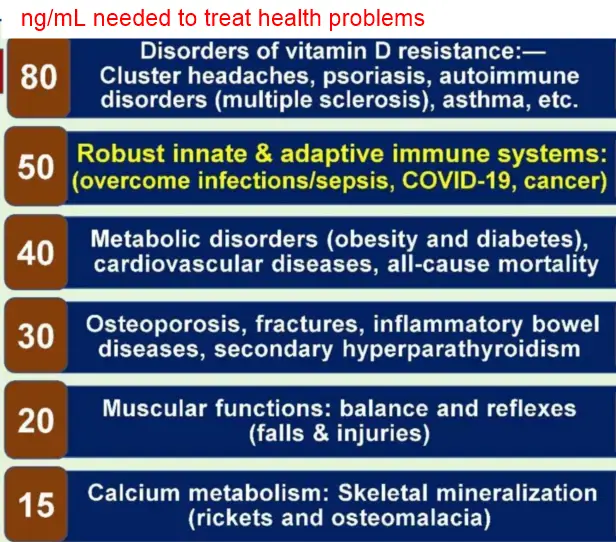
Is 50 ng of vitamin D too high, just right, or not enough
Vitamin D Treats 150 ng Multiple Sclerosis ✻ 80 ng Cluster Headache ✻
Reduced office visits by 4X ✻70 ng Sleep ✻ 60 ng Breast Cancer death reduced 60%
Preeclampsia RCT50 ng COVID-19
T1 Diabetes
Fertility
Psoriasis
Infections Review
Infection after surgery40 ng Breast Cancer 65% lower risk
Depression
ACL recovery
Hypertension
Asthma?30 ng Rickets ✻ Evolution of experiments with patients, often also need co-factors
50 ng and COVID
Is 50 ng of Vitamin D enough to fight COVID - TrialSiteNews - Jan 2024
COVID etc. prevented and treated with 50,000 IU Vitamin D capsules - July 2022
Discussion of COVID and 50 ng of Vitamin D (video and transcript)– Dr. Campbell Nov 17, 2021
COVID probably fought by Vitamin D, might need 50 ng - Dr. Patrick Nov 8, 2021
COVID-19 mortality extrapolates to zero at 50 ng of vitamin D – 18th Meta-analysis Sept 2021
Vitamin D and COVID, review of evidence, loading dose if less than 50 ng - Masterjohn Sept 2021
T-cells need at least 40-50 ng of Vitamin D to fight COVID-19 - June 2021
To protect against COVID-19, how much vitamin D – 20 to 50 ng – March 19, 2021