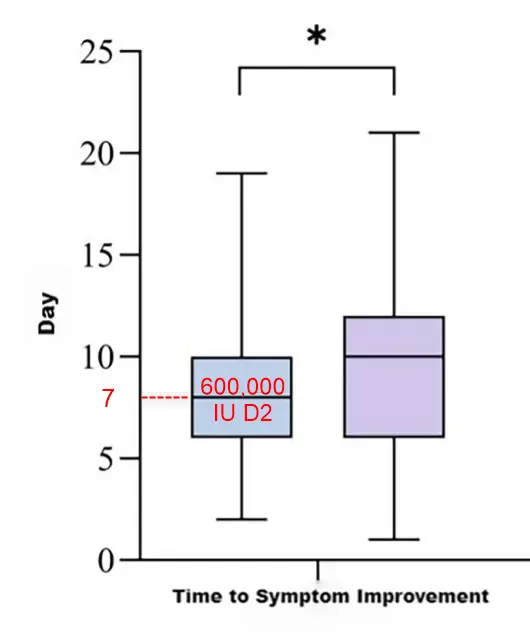
COVID symptoms improved in 7 instead of 10 days with 600,000 IU Vitamin D2 injection
Vitamin D Supplementation Improves Serological Parameters and Recovery Outcomes in COVID-19 Patients
Endocr Metab Immune Disord Drug Targets. 2026 Mar 11. doi: 10.2174/0118715303457486260113044737
Zhaoying Chen 1, Jianping Sheng 2, Qihang Ma 3, Wanpeng Wang 4, Lijie Wang 2, Lin Yang 2, Lin Liu 1, China
Introduction: This study aimed to investigate the effects of vitamin D on serological, etiological, and imaging indicators in patients with Coronavirus Disease 2019 (COVID-19), exploring new strategies for its prevention and treatment.
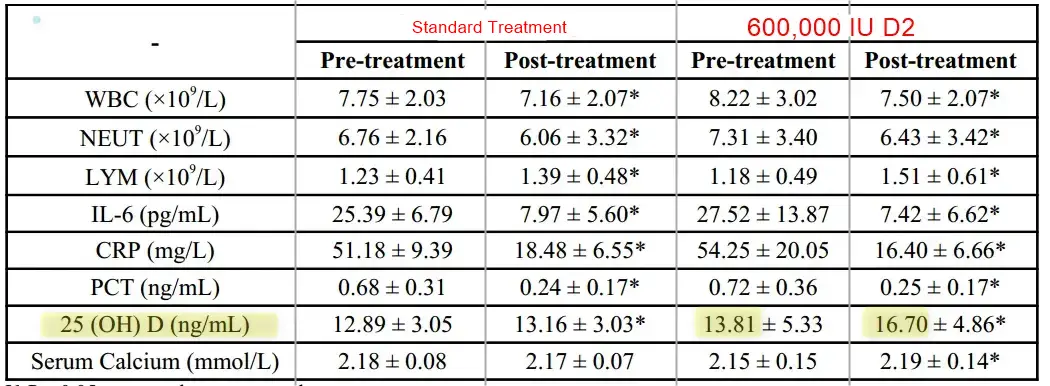
Methods: In this retrospective observational study, 300 COVID-19 patients admitted between January 2022 and March 2023 were enrolled from a public health center and our hospital. Participants were stratified into standard treatment (n=150) and vitamin D supplementation (n=150) groups. Outcomes included clinical recovery and improvements in laboratory, etiological, and imaging findings.
Results: No significant intergroup differences were observed at baseline in demographic or laboratory parameters, including white blood cell (WBC), neutrophil (NEUT), lymphocyte (LYM), interleukin (IL)-6, c-reactive protein (CRP), procalcitonin (PCT), and serum calcium (P > 0.05). Both groups exhibited subnormal 25(OH)D levels initially. After adjusting for age, sex, hypertension, diabetes, and cardiovascular and cerebrovascular diseases, multivariable linear regression analyses indicated that the vitamin D group showed significant increases in 25(OH)D and serum calcium, while the standard treatment group exhibited only a mild increase in 25(OH)D with no significant change in serum calcium after treatment. Both groups showed decreases in WBC, NEUT, IL-6, CRP, and PCT, and increases in LYM after treatment. Compared with the standard group, the vitamin D group had greater improvements in NEUT, LYM, 25(OH)D, and serum calcium (P < 0.05), and more pronounced reductions in IL-6 and CRP (P < 0.05). Symptom resolution and viral clearance times were significantly shorter in the vitamin D group (P < 0.05), and imaging improvements were more evident (P < 0.05).
Conclusion: Supplementation with vitamin D, in addition to standard treatment, improves inflammatory markers, shortens the disease course, and is associated with radiographic improvement in COVID-19 patients.
Nanoemulsion D3 should have produced a much faster response
- 60 days: Response to Injection
- 7 days: Response to Oral vitamin D3
- 2 days: Response to nanoemulsion Vitamin D3 swished in mouth
Related in Vitamin D Life
- Vitamin D injection did not help critically ill children (injection take too long to help)
- 15.3 X fewer COVID deaths in those getting Vitamin D injections in ICU – RCT
- Oral Vitamin D much better than injection (after Knee Arthroplasty in this case)
- Injection
- Many Chronic Health Diseases and Infections care controlled by 40 ng of Vitamin D – Sunil
has the followihg tableVitamin D Treats 150 ng Multiple Sclerosis ✻ 80 ng Cluster Headache ✻
Reduced office visits by 4X ✻70 ng Sleep ✻ 60 ng Breast Cancer death reduced 60%
Preeclampsia RCT50 ng COVID-19
T1 Diabetes
Fertility
Psoriasis
Infections Review
Infection after surgery40 ng Breast Cancer 65% lower risk
Depression
ACL recovery
Hypertension
Asthma?