
Hypertension is half as likely in those with good vitamin D and physical activity
Joint associations of 25-hydroxyvitamin D and physical activity with hypertension: Evidence from the ELSA study and genome-wide data
Br J Nutr. 2026 Apr 13:1-21. doi: 10.1017/S0007114526107053
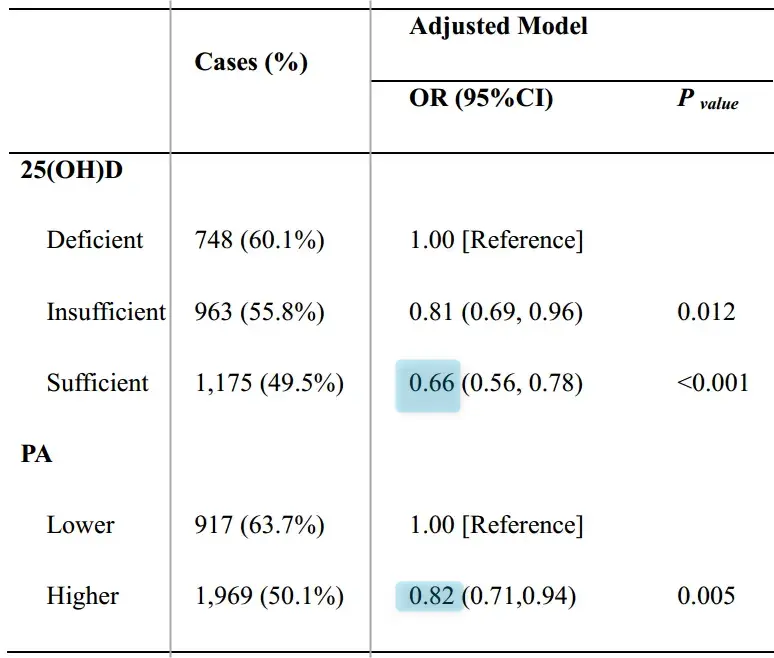
The interaction between 25-hydroxyvitamin D [25(OH)D] and physical activity (PA) in influencing hypertension remains underexplored. This study aimed to examine their independent and joint associations with hypertension risk among 5,327 participants aged ≥50 years from the English Longitudinal Study of Ageing. Participants were categorized by 25(OH)D status (sufficient, ≥50 nmol/L; insufficient, ≥30 to <50 nmol/L; deficient, <30 nmol/L) and self-reported PA levels. Multivariable logistic regression, adjusting for the season of measurement and sociodemographic confounders, showed that sufficient 25(OH)D (OR = 0.66, 95% CI: 0.56-0.78) and higher PA (OR = 0.82, 95% CI: 0.71-0.94) were independently associated with reduced hypertension prevalence. In joint analyses, the group combining higher PA and sufficient 25(OH)D exhibited the lowest odds of hypertension (OR = 0.55, 95% CI: 0.43-0.70) compared to the lower PA and deficient group. A significant synergistic interaction was identified, indicating that the combined protective effect of these factors was greater than the sum of their individual associations. These results were corroborated by Mendelian randomization analysis, which identified inverse causal associations between genetically predicted 25(OH)D, vigorous PA, and hypertension risk across independent datasets.
These findings emphasize that vitamin D sufficiency acts in synergy with an active lifestyle to enhance cardiovascular protection. This relationship underscores the critical importance in nutritional science of integrating micronutrient status with physical activity to develop more effective, multifaceted lifestyle-based strategies for hypertension management in middle-aged and older populations.
Related in Vitamin D Life
- Death after pre-hypertension 4X more likely if very low Vitamin D
- Hypertension reduced by Vitamin D if taken daily to every 14 days by who were deficient
- Drug-resistant hypertension 3.5 X more likely if low vitamin D
- Hypertension risk increased 2.1 X if poor Vitamin D Receptor
- Hypertension not reduced much if use less than 5,000 IU of Vitamin D – meta-analysis
Magnesium
- Hypertension treatment needs at least 600 mg of Magnesium (49 trials)
- Hypertension 1.5X more likely if low level of Magnesium
- Magnesium raised Vitamin D, lowered blood pressure and Ca to Mg ratio – RCT
- Hypertension reduced by Magnesium plus 3,000 IU of vitamin D for 12 weeks – RCT
- Hypertension 5 X more likely if low Vitamin D, A, Calcium and Magnesium
- Magnesium reduces hypertension - FDA allows claim