
Metabolic Syndrome
Related in Vitamin D Life
Metabolic Syndrome risk decreases by 20 percent with each 10 ng increase in Vitamin D - April 2021
Metabolic Syndrome and Vitamin D - review of 33 studies - March 2021
Metabolic Syndrome far less likely if high Vitamin D – 3 meta-analyses 2021
Metabolic Syndrome 11X more likely if have a poor Vitamin D Receptor – 2018
Vitamin D is linked to metabolic syndrome and obesity – Aug 2019
- Boron and Metabolic Disorders
The Role of Magnesium in the Pathogenesis of Metabolic Disorders
Metabolic Syndrome risk reduced 3.7 X by nuts (Magnesium, Omega-3) – Dec 2018
Metabolically Healthy – only 1 in 50 seniors in the US – Nov 2018
Metabolic Syndrome indicators inversely proportional to vitamin D below 46 ng – Nov 2018
Metabolic Syndromes fought by Vitamin D in 6 ways – Oct 2023

Proposed new name for Metabolic Syndrome: Circadian Syndrome - 2019
Metabolic Syndrome 36% less likely if high vs low Vitamin D - May 2026
Serum 25-hydroxyvitamin D and metabolic syndrome: a large cross-section study with dose response analysis in a health screening population
Front Nutr. 2026 Apr 30:13:1809892. doi: 10.3389/fnut.2026.1809892
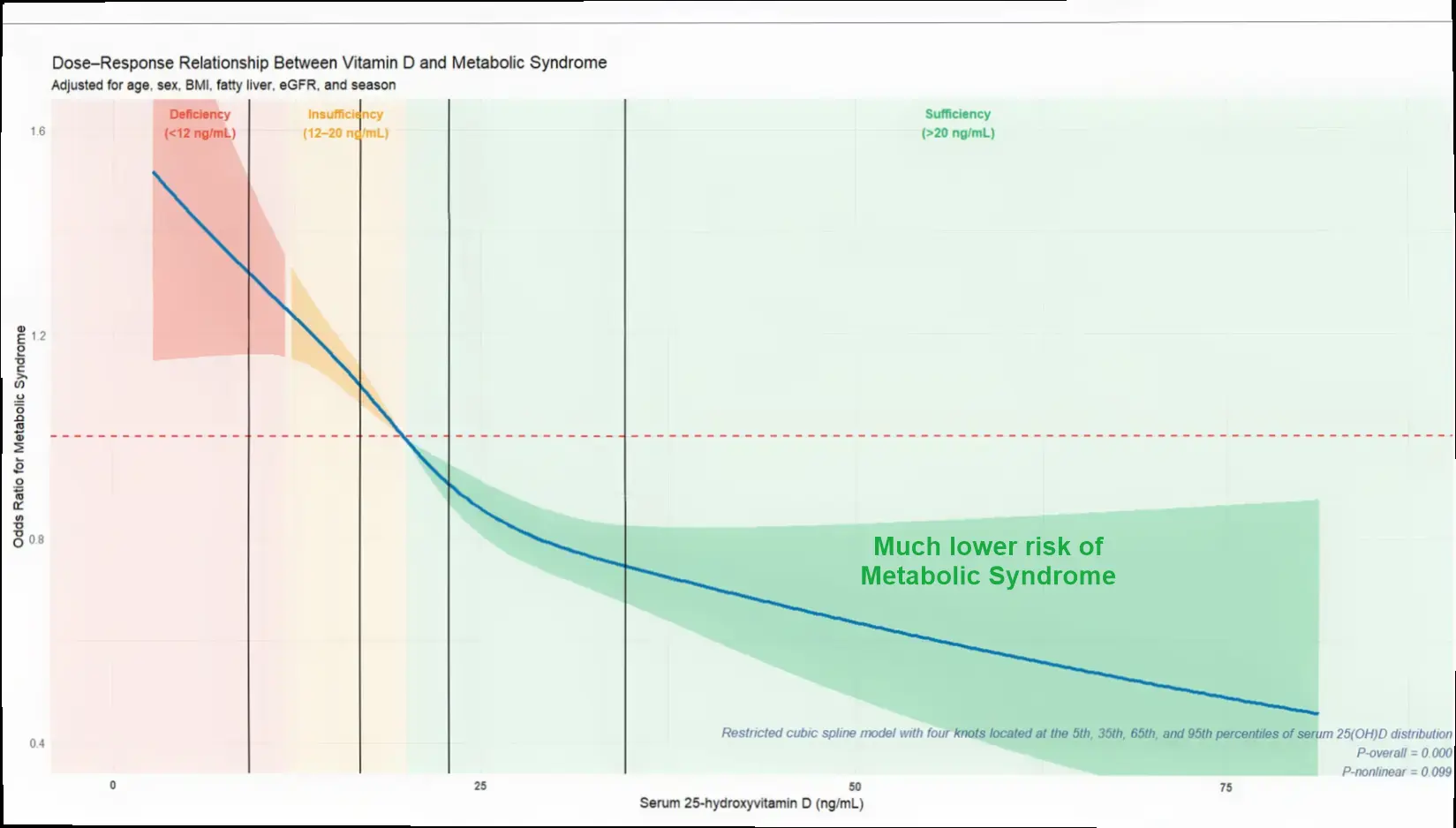
Background: The association between serum 25-hydroxyvitamin D [25(OH)D] and metabolic syndrome (MetS) remains controversial, particularly in large-scale health-screening populations where early metabolic abnormalities can be detected. This study aimed to investigate the independent and potential non-linear association between serum 25(OH)D levels and MetS in adults undergoing routine health examinations.
Methods: This cross-sectional study included 29,214 adults who underwent routine health examinations at a tertiary hospital between January 2024 and November 2025. MetS was defined according to the 2023 Chinese expert consensus criteria. Multivariable logistic regression models with sequential adjustment were used to estimate odds ratios (OR) and 95% confidence intervals (CI) across quartiles of serum 25(OH)D. Restricted cubic spline (RCS) analysis was performed to explore potential non-linear dose-response relationships. Sensitivity analyses included exclusion of outliers, additional adjustment for hepatic and renal function indicators, and E-value estimation to assess robustness to unmeasured confounding.
Results: Among 29,214 participants, 6,002 (20.5%) were diagnosed with MetS. After multivariable adjustment, higher serum 25(OH)D levels were independently associated with lower odds of MetS. Compared with the lowest quartile (Q1, <14.9 ng/mL), participants in the highest quartile (Q4, >25.2 ng/mL) had a 36% lower likelihood of MetS (OR = 0.64, 95% CI: 0.57-0.71). RCS analysis demonstrated an inverse dose-response relationship, with the strongest risk reduction observed above approximately 20 ng/mL.
Conclusion: In this large health screening-based population of 29,214 adults, higher serum 25(OH)D concentrations were independently associated with lower odds of metabolic syndrome after comprehensive adjustment for potential confounders. Although the findings support a robust inverse association, causal inference cannot be established, and residual confounding may remain. Prospective cohort studies and well-designed randomized trials are warranted to clarify whether vitamin D plays a causal role in the development of metabolic syndrome or primarily reflects underlying metabolic health status.
Categories associated with Metabolic Syndrome
Obesity19; Diabetes15; Cardiovascular12; Magnesium8; Seniors8; Women5; 5; Hypertension5; Intervention5; Omega-34; Youth4; Meta-analysis 4
As of Oct 2022