
Children of Pacific Islands: 96% have insufficient Vitamin D
Quadruple burden of young child malnutrition in the Children's Healthy Living program, US Affiliated Pacific
J Nutr. 2026 Apr 8:101527. doi: 10.1016/j.tjnut.2026.101527 PDF is behind a paywall
R Novotny 1, R Dela Cruz 2, K Hammond 2, A B Yamanaka 2, L R Wilkens 3, L Shallcross 4, P Coleman 5, T F Aflague 6, T Fleming 7, J Deenik 2, J Butel 2
Purpose: To examine the quadruple burden of malnutrition in children among jurisdictions of the US affiliated Pacific (USAP) region.
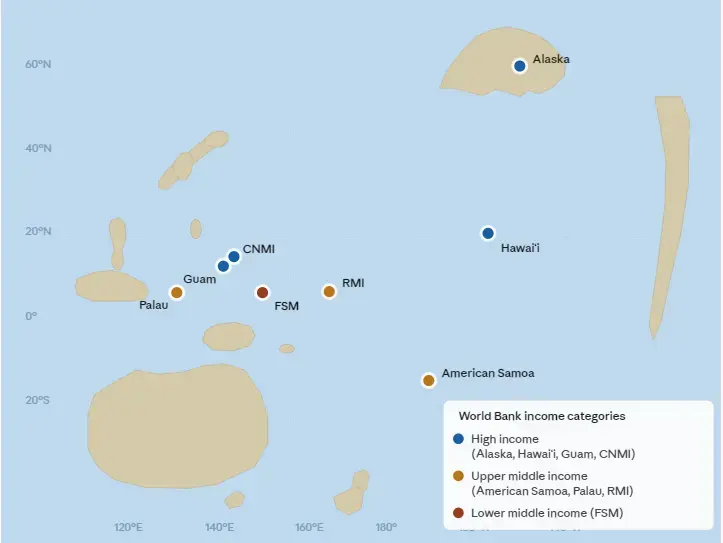
Methods: 3480 children in 11 jurisdictions from the USAP region (Alaska, American Samoa, Commonwealth of the Mariana Islands (CNMI), Federated States of Micronesia (FSM), Guam, Hawai'i). Jurisdictions were categorized according to the World Bank income categories of lower middle income (FSM), upper middle income (American Samoa, Palau, Republic of the Marshall Islands, RMI), and high income (Hawai'i, Alaska, Guam, CNMI). Four population indicators were evaluated - 1) obesity and 2) stunting using standardized measured anthropometry, and 3) inadequacy and 4) excess of dietary intake of micronutrients of concern globally (iron, zinc and vitamin A) and in the region (vitamin D, vitamin E, calcium, niacin, folate, and sodium). Frequencies of each malnutrition form were computed.
Results: Across the USAP region, there was at least 10% of children with each form of malnutrition.
The overall prevalence of stunting across all jurisdictions was 11.4%; varying from a low in American Samoa at 1.7% to a high in RMI at 40%.
Overall prevalence of obesity was 13.6%, ranging from a low in RMI of 0% to a high in American Samoa of 25.4%. Overall prevalence of (any of the 9 studied) micronutrient inadequacies was 98.1%, driven by dietary Vitamin D inadequacy (96.0%). Overall prevalence of micronutrient excess was 96.2%, driven by sodium excess (92.4%).
Conclusion: There is a quadruple burden of malnutrition in the USAP. Micronutrient inadequacy and excess are the most important forms of malnutrition at 98.1% and 96.2%, respectively. Nutrition promotion should focus on healthy diets, especially in regions undergoing nutrition transition.