
Half as many headaches if high Vitamin D level (age 6-19)
Vitamin D concentrations and headache risk in children and adolescents aged 6 to 19 years: The mediating role of body mass index
Medicine (Baltimore). 2026 May 1;105(18):e48477. doi: 10.1097/MD.0000000000048477.
Min Zhang 1, Juan Xie 2, Cheng Guo 3, Tiesong Zhang 1, Kai Liu 3
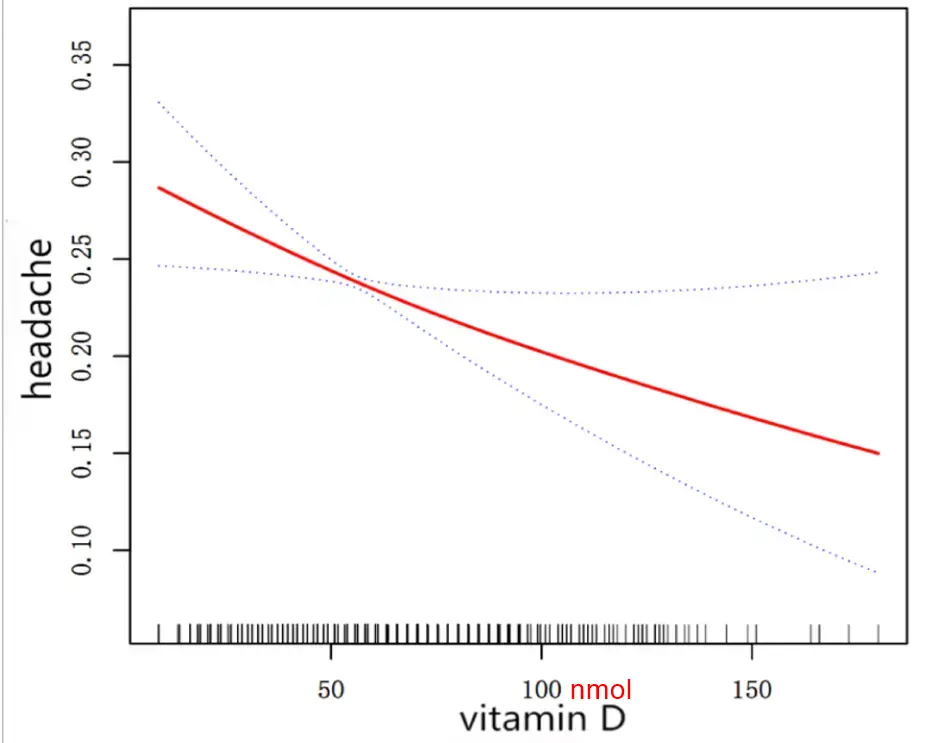
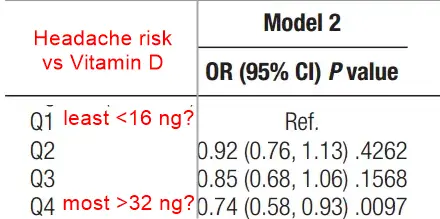
Emerging evidence suggests vitamin D deficiency might be linked to increased headache risk, though consistent conclusions are lacking due to population and methodological heterogeneity. In addition, childhood and adolescent obesity may influence headache development through metabolic and inflammatory pathways, but the specific role of body mass index (BMI) in the relationship between vitamin D and headache is currently unclear. Therefore, this study used National Health and Nutrition Examination Survey (NHANES) large-scale population-based data to investigate the association between vitamin D levels and headache risk in children and adolescents aged 6 to 19 years and to analyze the possible mediating effect of BMI on this relationship. The aim of this study was to explore the complex association between vitamin D levels and headache.
We analyzed 2 cycles of the NHANES dataset, which included a total of 7066 children and adolescents aged 6 to 19 years. Multivariate linear regression models, subgroup analyses and smoothed curve fitting were used to investigate the associations between vitamin D levels and headache, and the potential mediating role of BMI was explored. The results of the present study revealed a evident negative correlation between vitamin D levels and headache risk in children and adolescents, a finding that was further supported by smoothed curve fitting.
Notably, this negative correlation was stronger in the female and adolescent groups. The results of the mediation analysis revealed that BMI had a evident mediating effect, with a mediation ratio of 20.94%. This study found that lower vitamin D levels were associated with a higher likelihood of headache in children and adolescents, and that BMI may play a partial mediating role. This finding provides new strategies for the prevention and treatment of headache in children and adolescents. More prospective studies are necessary to further validate this association and its underlying mechanisms.
This study looks at regular and migraine, but not cluster headaches.
Related in Vitamin D Life
- Migraine headache 5X less likely if optimal level of vitamin D
- Headache
- Magnesium and Migraines - many studies
- see also Tags: at the bottom of this page