
Vitamin D can start working in minutes — if you pick the right form
Speed of response: minutes to weeks
- nanoemulsion inhaled (minutes)
- nanoemulsion swished in mouth (minutes)
- inhaled vitamin D
through nose if need in brain
through mouth if needed in lungs - Calcitriol injection - prescription only (hour)
- nanoemulsion oral (hour)
- topical (hour
- liposomal (hours)
- patch (hours)
- powder in pill - water dispersible (day)
Pour powder into water, then swish water in mouth for 2 minutes - oil in capsule or liquid (days)
- injection (weeks)
When a Fast Response is wanted
- You or a person near you is getting symptoms of a possible viral infection
- Accident that requires hospitalization
- In Intensive Care Unit (ICU)
- Stop asthma, etc. attack
A slow response (injection) is wanted when unsure a person will take the supplement
Additional concerns: fat needed, time of day, increased bio-availability, genes, co-factors, gut-friendly
Response time for injections - Claude AI April 2026
Calcitriol (1,25(OH)₂D) injection — 1 hour.
It's already the active hormone, so it binds VDR immediately with no conversion needed. Plasma peak is roughly 1 hour after IV. PTH suppression is detectable within a few hours, with maximum suppression around 24–48 hours. Plasma half-life is short (~5–8 hours), but biological effects persist 3–5 days because of nuclear VDR binding. This is why dialysis units dose it 3×/week IV.
Calcidiol (25(OH)D, calcifediol) injection - 4 hours
Hours to raise the serum marker, but ~1–4 days for full downstream effect.Serum 25(OH)D rises within 4–8 hours of an IM or oral dose (compare to weeks for D3 to plateau). However, the biological effect still requires 1α-hydroxylation in the kidney (or peripherally) to calcitriol, so PTH and calcium effects lag the 25(OH)D rise by roughly a day or two. Half-life is ~15 days, so a single dose holds levels up for weeks.
Related in Vitamin D Life
- Fast responses to Vitamin D – loading dose, nanoemulsion and Calcifediol
- Response to Vitamin D - many studies
- Responses to 3600 IU Vitamin D or Calcifediol
- Some supplements: Vitamin D, Vitamin K, Omega-3, etc. must be taken with fatty meals
- Microencapsulated Vitamin D better than oil-based in 6 ways
- 30-40 % of people dislike swallowing pills (note: there are many other forms of Vitamin D)
- Perhaps 10% of people will do better with Calcidiol than Vitamin D
- Fast responses to Vitamin D – loading dose, nanoemulsion and Calcifediol
- Gut-Friendly Vitamin D
- Getting Vitamin D into your blood and cells has
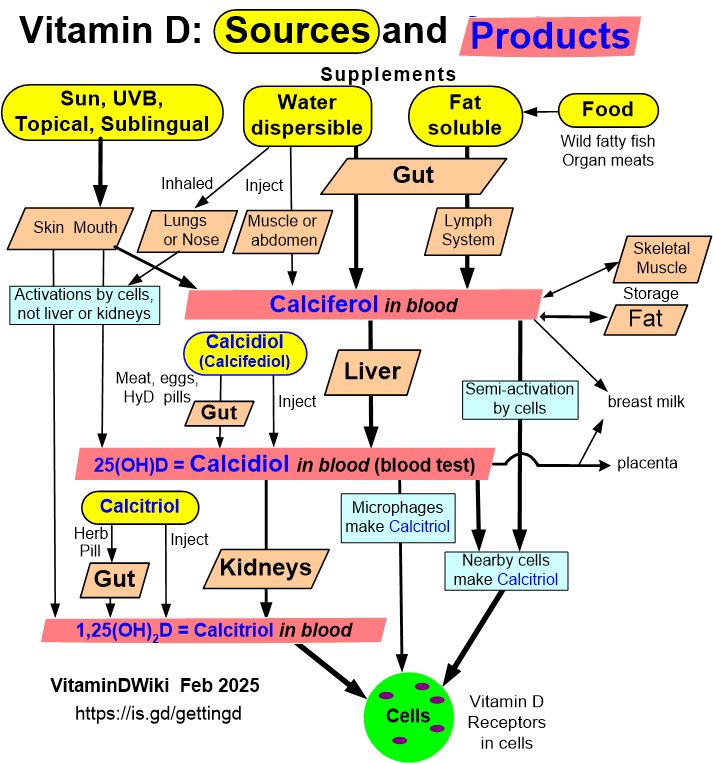
Liposomal
- Liposomal Vitamin D3 compared with Calcidiol(Calcifediol)
- 5 X faster response to Liposomal Vitamin D than oil-based Vitamin D
- Liposomal Vitamin D appears to have a 3X faster and better response
Oil Based
- Vitamin D in powder (Bio-Tech) better than in oil (Thesis with Cystic Fibrosis patients)
- Olive oil problem with Vitamin D (again)
Tags at the bottom of page include : injection, Topical, Nanoe, Liposomal Calcidiol, Gut-Friendly