
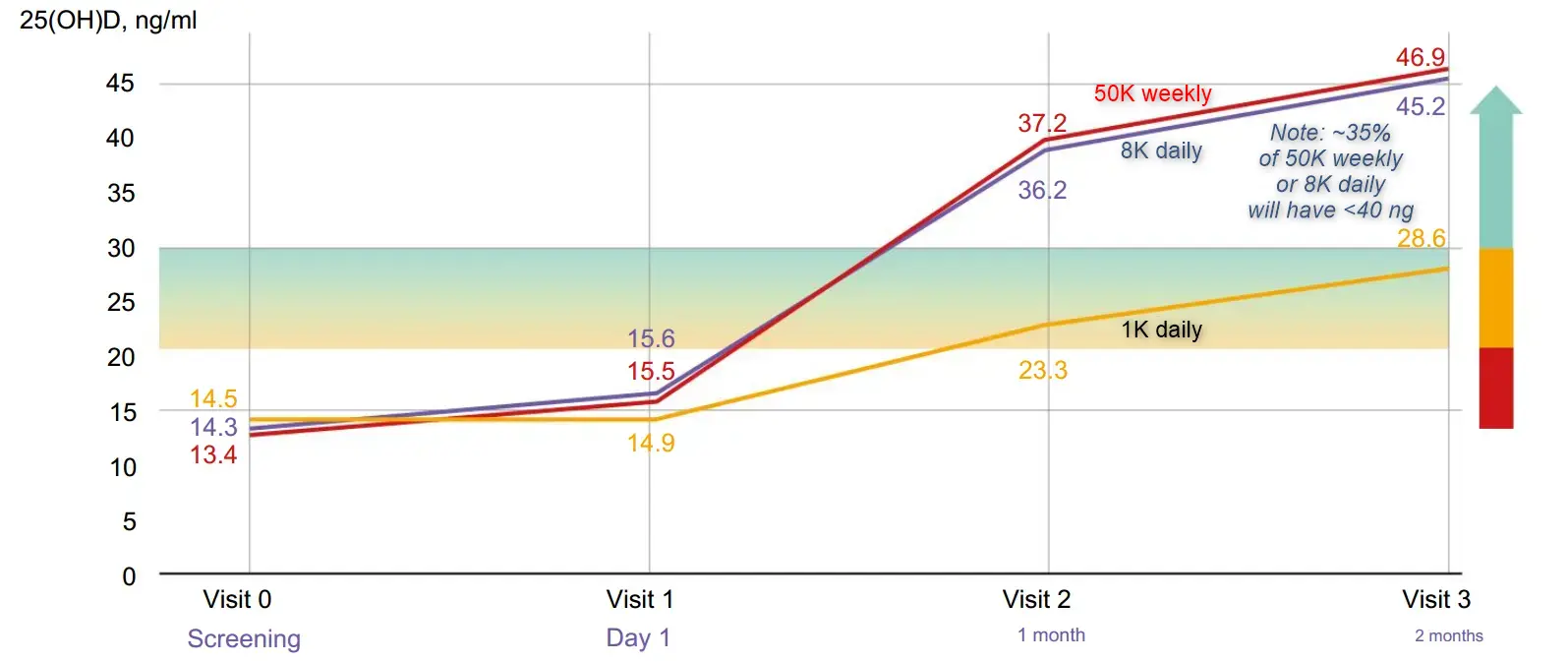
Vitamin D: need 30 to 60 ng (50,000 IU weekly) RCT (Russia)
OPTIMAL 25(OH)D SERUM LEVEL IN RELATION TO ASSOCIATION WITH MUSCULOSKELETAL, METABOLIC, NEUROLOGICAL, AUTOIMMUNE AND INFECTIOUS DISEASES
Problems of Endocrinology 2025;71(6):40-49 https://doi.org/10.14341/probl13687
E.A. Troshinal , E.A. Pigaroval *, T.L. Karonova2 , F.Kh. Dzgoeval , V.E. Radzinsky3 , I.I. Baranov4 p.M. Lesnyak5 , Yu.E. Dobrokhotova6 , I.V. Kuznetsova7 , N.V. Zarochentseva8 , G.R. Bayramova4 , P.A. Radaeva9 , E.V. Ekusheva10, L.A. Suplotovall, E.V. Matushevskaya10
This article presents an overview of current research on target vitamin D blood levels. It examines the biochemical and metabolic properties of vitamin D, as well as the challenges of standardizing 25(OH)D measurements and the variability of cutoff values across populations. It discusses the ambiguity of the scientific evidence and the need to consider individual factors when interpreting vitamin D levels. This review is unique in its comprehensive approach to analyzing the effects of vitamin D not only on bone health but also on immune and metabolic function, expanding the evolving understanding of the clinical significance of vitamin D. This paper emphasizes the importance of personalized recommendations for vitamin D prescription and dosing based on current clinical evidence and scientific standards. This analysis highlights the need for a personalized approach to vitamin D prescription to achieve and maintain blood levels of 30 to 60 ng/mL, noting that higher levels may be required for individuals with genetic or acquired resistance to the nutrient. The data obtained support the development of evidence-based, personalized clinical strategies for the prevention and treatment of diseases associated with vitamin D deficiency. The synthesized data are important for the development of research and clinical practice in the fields of endocrinology, obstetrics, dermatology, neurology, and immunology.
Related in Vitamin D Life
- Vitamin D update – 40-60 ng ideal, 50K biweekly maintenance
- 40 ng response to 4,000 IU daily Vitamin D for 2 months (and 60 ng for 8,000 IU)
- Need 40 to 60 ng of Vitamin D – 48 scientists call for action – 2015

- Prefer 40 – 60 ng of Vitamin D to minimize COVID-19
- Is 50 ng of vitamin D too high, just right, or not enough
- 10 reasons for poor response to Vitamin D (race, binding protein, etc.) many simple ways to boost response
- 40-50 ng level of Vitamin D often recommended
- Vitamin D: 40-70 ng is optimal, sometimes more is needed - Grant, Sunil, Pawel, Cheng
- Personalized treatment of Vitamin D
- Take 50,000 IU of Vitamin D weekly for 2-4 months, then get a test to confirm your goal has been reached
- 10,000 IU Vitamin D daily often needed to get to 40-80 ng (It has been 100 years since it’s discovery)
- Response by obese to weekly 50,000 IU of Vitamin D obese need about 2.5 X larger dose
- Health can be greatly improved by weekly 50,000 IU of Vitamin D - video Lahore the following chart is an educated guess for Iceland

Russia